
Carbon Credit
Program Expands
Enrollment Area
Into
The Carbon Credit pilot project offered by
the Chicago Climate Exchange (CCX) has recently expanded its enrollment area
into all of central and western
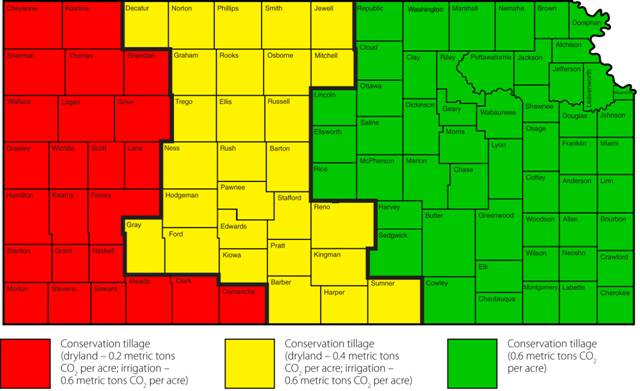
The new enrollment criteria are included
in the map below.
A. Eastern Kansas counties are now
eligible for a carbon credit of 0.6 metric tons of CO2 per acre per
year for conservation tillage for the years 2006-2010.
General eligibility criteria and
practices for the region include but are not limited to the following:
* Enrolled acres may be planted in
soybeans no more 50 percent of the enrolled years;
* Continuous cotton and soybeans are
eligible only if there is a cover crop;
* Eligible implements include: no-till
drill, no-till and strip-till planters, rolling harrows, low disturbance liquid
manure injectors, anhydrous ammonia applicator, manure knife applicator, sub-soil
ripper with at least 24-inch shank spacing.
* Ineligible implements include: field
cultivators, tandem disk, offset disk, chisel plow, moldboard plow.
* Histosol soils in Land Resource
Region T are not eligible;
* In general if the implement would
require that a leveling or smoothing activity follow, it would likely result in
too much soil disturbance
* Fallowed acres are not eligible in
this region.
* No Exchange Soil Offsets will be
issued in years in which residue removal occurs.
* Residue burning is not allowed.
B. In central
General eligibility criteria and practices for the
region include but are not limited to the following:
* Irrigated acreage eligible for enrollment provided
that the acreage began irrigation prior to March 26, 2007. Exchange Soil Offsets will
be issued to eligible irrigated acres at a rate of 0.6 metric tons per acre per
year.
* Enrolled acres may be planted in soybeans no more
50 percent of the enrolled years;
* Continuous cotton and soybeans are eligible only if
there is a cover crop;
* Histosol soils in Land Resource Region T are not
eligible;
* Eligible implements include: no-till drill, no-till
and strip-till planters, rolling harrows, low disturbance liquid manure
injectors, anhydrous ammonia applicator, manure knife applicator, sub-soil
ripper with at least 24-inch shank spacing.
* Ineligible implements include: field cultivators,
tandem disk, offset disk, chisel plow, moldboard plow.
* In general if the implement would require that a
leveling or smoothing activity follow, it would likely result in too much soil
disturbance
* Fallowed acres are not eligible in this region.
* No Exchange Soil Offsets will be issued in years in
which residue removal occurs.
* Residue burning is not allowed.
C. In western
General eligibility criteria and
practices for the region include but are not limited to the following:
* Irrigated acreage is eligible for
enrollment provided that the acreage began irrigation prior to March 26, 2007. Exchange
Soil Offsets will be issued to eligible irrigated acres at a rate of 0.6 metric
tons per acre per year.
* Enrolled acres may be planted in
soybeans no more 50 percent of the enrolled years;
* Continuous cotton and soybeans are
eligible only if there is a cover crop;
* Eligible implements include: no-till
drill, no-till and strip-till planters, rolling harrows, low disturbance liquid
manure injectors, anhydrous ammonia applicator, manure knife applicator, sub-soil
ripper with at least 24-inch shank spacing.
* Ineligible implements include: field
cultivators, tandem disk, offset disk, chisel plow, moldboard plow.
* In general if the implement would
require that a leveling or smoothing activity follow, it would likely result in
too much soil disturbance
* Fallowed acres are not eligible in
this region.
* No Exchange Soil Offsets will be
issued in years in which residue removal occurs.
* Residue burning is not allowed.
Other changes to the CCX carbon credit
program:
* CCX will no
longer accept new contract enrollments that utilize ridge-till. Current
contracts based on ridge-till practices will be honored through the current
contract period which ends December 31, 2010. The credit rate for existing
ridge-till contracts will remain at 0.5 tons CO2
per acre per year. Any current ridge-till enrollee who desires to
terminate the Soil Offset Contract with the Iowa Farm Bureau at this time may
do so without penalty or credit recovery.
* CCX will no longer issue carbon credits on row crop land
that has the crop residue removed (silage, straw baling, straw burning, corn
stalk baling, etc.). This does not apply to alfalfa or grass hay, or grass
pasturing. Land on which the residue is removed will receive zero "0"
credit for the year in which the residue is removed. Residue removal does
not nullify prior credits and will not trigger a credit recapture. It just
results in a zero "0" credit rate on the affected land for that year. Any
current contract enrollee who signed a contract with the understanding that
residue could be removed and who desires to terminate the Soil Offset Contract with
the Iowa Farm Bureau at this time may do so without penalty or credit recovery.
* New credit rates for grass plantings
are expected in the near future.
There
are many details and stipulations involved in this program, and producers should
review the contract closely. Producers can sign a
contract for the CCX program through either the Iowa Farm Bureau or National
Farmers Union.
In
the Iowa Farm Bureau’s program, producers can sign up for “Pool 5” from now
through June 30, 2007. This signup includes the expanded enrollment area under
the new criteria explained above. Producers interested in the Pool 5 phase of
this carbon credit pilot project can find a complete description of the program
and a copy of the XSO (Exchange Soil Offset) sales contract at:
www.iowafarmbureau.com/special/carbon/default.aspx
For
more information, contact David Miller, Iowa Farm
Bureau Federation, 515-225-5430, or e-mail: damiller@ifbf.org
The National Farmers Union is also
currently accepting new contracts for the expanded enrollment acres in the CCX
program. The criteria of the NFU carbon credit program are the same as those of
the Iowa Farm Bureau’s. The deadline for signing a carbon offset contract with
the NFU is August 15, 2007. Details of the program and a copy of the contract
can be found at: http://nfu.org/issues/environment/carbon-credits
For more information, contact
Current
prices on the CCX for carbon credits are currently averaging about $3.50 per
metric ton of CO2 equivalent.
The aggregators (Iowa Farm Bureau and National Farmers Union) determine when
the credits are sold on the market, and take a small percentage of this for
overhead.
The
CCX program also offers offset credits for methane and forestry plantings.
Complete details of the CCX offset programs and current prices can be found at:
http://www.chicagoclimateexchange.com/
-- Steve Watson, CASMGS Communications