
SOIL
CARBON AND CLIMATE CHANGE NEWS
From
Consortium for Agricultural Soils
Mitigation of Greenhouse Gases (CASMGS)
http://soilcarboncenter.k-state.edu
Charles W. Rice, K-State Department of
Agronomy, National CASMGS Director
(785) 532-7217 cwrice@ksu.edu
Scott Staggenborg, K-State Department of
Agronomy (785) 532-7214 sstaggen@ksu.edu
Steve Watson, CASMGS Communications (785)
532-7105 swatson@ksu.edu
March 15, 2007
No. 54
Science:
* Renewable Energy And Greenhouse Gas Emissions
* Perennial Biomass Ethanol Crops: Are Two
Species Better Than One?
* Carbon Credit Program Winter Meetings In
National:
* Actions On Several Fronts In
International:
* United Nations IPCC Issues
Latest Report On Global Warming
* Carbon Dioxide Levels Highest
In More Than 650,000 Years
* 2006 Sixth
Warmest Year On Record
**********
renewable energy
and
greenhouse gas emissionS
One of the ways agriculture is helping
reduced greenhouse gas emissions is through the production of renewable fuels
such as ethanol -- especially cellulosic ethanol. Corn-based fuel ethanol can
achieve moderate reductions in greenhouse gas (GHG) emissions compared to
gasoline, according to a report from Argonne National Laboratory. But cellulosic
ethanol can achieve much greater reductions in GHG emissions compared to gasoline.
See page 35 of the presentation at: http://www.transportation.anl.gov/pdfs/TA/347.pdf
The most detailed analysis of GHG
emissions from ethanol is in a report titled “Effects of Fuel Ethanol Use on
Fuel-Cycle Energy and Greenhouse Gas Emissions” from Argonne National
Laboratory. This report can be found at: http://www.ipd.anl.gov/anlpubs/1999/02/31961.pdf
The authors of this report calculated the
effect of various blends of ethanol-gasoline on GHG emissions, on the basis of
“Per Vehicle Mile.”
Current technology, corn-based ethanol:
* Use of E10 results in a 1 percent
reduction in GHG emissions
* Use of E85 results in a 14-19 percent
reduction in GHG emissions
Near-future technology, biomass-based (cellulosic)
ethanol:
* Use of E10 results in a 6-9 percent reduction
in GHG emissions
* Use of E85 results in a 68-102 percent
reduction in GHG emissions
E10 is a blend of 10 percent ethanol and
90 percent gasoline. E85 is a blend of 85 percent ethanol and 15 percent
gasoline.
The wide range of emissions reductions for
biomass-based ethanol reflects the different possible feedstocks that could be
used. Cellulosic ethanol made from herbaceous biomass achieves smaller
reductions in GHG emissions than does cellulosic ethanol from woody biomass.
How can ethanol result in greater than a
100 percent reduction in emissions (e.g. E85 ethanol from biomass)? This is
attributable to the elimination of emissions from electric power plants. Electricity
generated in cellulosic ethanol plants, because of the plant design, exceeds the
internal needs of the plant. The excess is exported to the electric grid,
reducing emissions from other generators of electricity.
The bottom line is that cellulosic ethanol
can potentially achieve significant energy and GHG emissions reduction benefits.
The production and use of ethanol has a
fundamentally different impact on the CO2 cycle than the production and use of petroleum
fuel. The impact is different for grain-based than biomass-based ethanol
production. The production of grain-based ethanol requires more inputs than
biomass-based ethanol, which affects the overall GHG emissions balance. And
grain-based ethanol production has a more uncertain effect on soil carbon
sequestration and sustainability than cellulosic ethanol production.
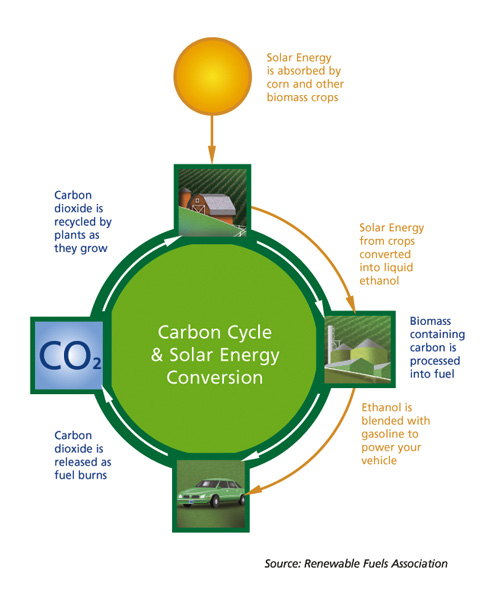
The basic carbon/ethanol cycle is:
There are four primary reasons that the
production and use of ethanol reduces GHG gas emissions.
1. Less CO2 is emitted from the tailpipe when burning ethanol
instead of gasoline. Burning ethanol (from any source) releases less CO2 into
the atmosphere than gasoline, according to a report from the Energy Information
Administration (EIA), U.S. Department of Energy. See: http://www.eia.doe.gov/cneaf/alternate/page/environment/chap3.html
Ethanol releases
325.5 grams of CO2 per vehicle mile traveled, compared to 347.3 grams for
gasoline. Ethanol does release much more water vapor into the atmosphere than
gasoline per vehicle mile traveled. Currently, however, water vapor from fuel combustion
is not believed to have a significant impact on atmospheric water vapor
concentrations, according to the EIA report.
2. The carbon-based energy captured in grain and plant materials is
used directly as a fuel source, completing the carbon cycle. Plants take CO2
from the atmosphere and convert it to carbohydrates using the sun as an energy
source. The carbon is then converted within an ethanol plant into combustible
fuel, which enters the atmosphere when it is burned by vehicles. These carbon
emissions are then used by next year’s crop and the cycle is complete.
When plant
materials are not used for ethanol, part of the carbon is eventually
sequestered in the soil and part is emitted into the atmosphere as the plant
material decomposes on the soil surface. When plant materials are used for
ethanol, the portion of the carbon that would normally be decomposed and released
into the atmosphere is instead used to replace fossil fuel combustion.
3. With perennial biomass-based ethanol crops, there is an
increase in the amount of root mass and an elimination of tillage. This results
in an increase in the amount of carbon sequestered in the soil. Also, the lignin
by-product of cellulosic ethanol production can be used to at least partially
fuel the operation of the ethanol production plant itself, meaning less
reliance on coal, natural gas, or other fuels. The CO2 emissions released by
the combustion of lignin to fuel the ethanol plant are treated as zero because
they are taken up again by the corn or biomass plants during photosynthesis.
4. Cellulosic ethanol plants can potentially generate excess
electricity from the combustion of lignin through co-generation facilities, and
that electricity is exported to the power grid. This direct offset reduces the
emissions that would have come from the normal process used by the power plant.
There is some variability in the amount of GHG emissions reductions
from renewable energy because of many factors, such as the:
* Different types of fuel used to operate ethanol production
plants. Many ethanol production plants currently use coal or natural gas as the
primary energy source in their operations. Plants that use biomass combustion
to fuel the plants have the most favorable GHG emissions balance.
* Amount of inputs needed to raise the ethanol feedstocks. With
corn-based ethanol, considerable nitrogen fertilizer is used in the production
of corn. The potential nitrous oxide emissions from the increased fertilizer
use offsets some of the benefits of reduced CO2 emissions.
* Fuel use in feedstock production. The amount of equipment time
used in the production of the feedstock will have an impact on the overall GHG
emission budget.
* Soil management and tillage practices. If soils are subject to
increased erosion or tillage intensity during the production of biofuels, this
can cause an increase in carbon emissions from land use changes and offset some
of the benefits.
* Yield of the feedstocks compared to the inputs used. Corn producers
are getting higher yields per unit of input now than in years past, which
improves the overall energy and GHG emissions balance.
* Method and distance of transportation needed to take the ethanol
from the production plant to the end user.
The estimates on GHG emissions reductions
from the production and use of ethanol are based on the GREET model (Greenhouse
gases, Related Emissions, and Energy use in Transportation) from the Center for
Transportation Research at Argonne National Laboratory. For details of the
GREET model, see:
http://www.transportation.anl.gov/software/GREET/
-- Steve Watson, CASMGS Communications
**********
perennial biomass
ethanol crops:
are two species
better than one?
Cellulosic ethanol from
perennial biomass crops has many potential benefits. But which perennial
biomass crops will have the greatest benefit, and where are they adapted?
Recent research suggests that one single grassland perennial crop may not be
the best choice, at least in some circumstances. A mixture of native grassland
perennials may produce more net energy because of fewer inputs needed per unit
of production, according to a new study published in the journal Science.
In addition, the grassland
species sequester more carbon than they produce. The findings suggest diverse
prairie grasses grown on soils no longer suitable for agriculture can
substitute for corn and soybean biofuels, keeping food acreage in production
while sequestering greenhouse gases.
A team of ecologists at the
Although the yield of biofuels from prairie grasses was about 33 percent lower per hectare than from cultured crops such as corn, the inputs (fertilizer, fuel for tractors, etc.) required to grow them are much lower. So the net energy output from native grasses is actually about five-fold compared to 1.25-fold for corn and 1.93-fold for soybeans. As a bonus, three-quarters of the prairie grasses' mass is in their root structure, allowing the plants to store a net 4.4 metric tons of carbon per hectare every year, a relatively large amount in the fight against climate change.
For more information, see:
http://sciencenow.sciencemag.org/cgi/content/full/2006/1207/5
-- Steve Watson, CASMGS
Communications
**********
Carbon credit
program
winter meetings
in
Over
the winter of 2006/07, there were several farmer meetings in
Farmers in
The Iowa Farm Bureau (IFB)
has enrolled 14,200 acres from
For more information,
producers can email Dave Miller, with the Iowa Farm Bureau, at: damiller@ifbf.org
The Farmers Union carbon
credit program has had 21,303 acres in
Sign-up through the NFU is ongoing. The next cut-off will probably be in late
summer of 2007. The NFU carbon web site is at: http://www.nfu.org/
For more information,
producers in
In the current program,
no-till acreage in western
-- Steve Watson, CASMGS Communications
**********
Actions On Several Fronts In
To Limit Greenhouse Gas emissions
A consensus is building
within the
1. States.
* Western states. Governors from five western
states have signed an agreement in late February called the Western Regional
Climate Action Initiative to work together to reduce greenhouse gases by
establishing economy-wide GHG emissions caps. The governors of
* Northeastern states. Nine northeastern states have joined
together to form the Regional Greenhouse Gas Initiative (RGGI), which will set
GHG emissions caps only on electricity generators. RGGI states currently
include
* Others.
2.
*
Carper (D-DE) and Feinstein (D-CA). Senate. Electric Utility Cap-and-Trade Act.
Would place emissions caps only on electricity generators.
*
Kerry (D-MA) and Snowe (R-ME). Senate. Global Warming Reduction Act. Economy-wide
emissions caps; establishes a national renewable energy quota of 20 percent by
2020.
*
Lieberman (I-CT) and McCain (R-AZ). Senate. Climate Stewardship and Innovation
Act. Caps electric power, industrial, commercial, and transportation sectors;
allows
*
Sanders (I-VT) and Leahy (D-VT). Senate. Global Warming Pollution Reduction
Act. Established economy-wide emissions caps; nationwide renewable energy
quotas; energy efficiency goals; credit trading programs.
*
Olver (D-MA) and Gilchrest (R-MD). House. Climate Stewardship Act. Similar to
Lieberman-McCain bill in Senate.
3. Voluntary business and
environmental organization coalitions. Just a few examples include:
*
*
Greenhouse Gas Offset Acquisition Initiative. Five
The U.S. Greenhouse Gas Offset Acquisition Initiative, run
by the environmental consulting firm M.J. Bradley and Associates, together with
offset buyer The Oregon Climate Trust, recently launched a nationwide request
for project proposals aimed at reducing greenhouse gases.
The
firms seek to offset emissions from power companies operating in the
northeastern
*
GE-AES Partnership. AES Corp. and GE Energy Financial Services plan to create a
partnership to develop greenhouse gas emission reduction projects in the
In addition to methane-based projects, the partnership may also pursue
development of offsets through energy efficiency projects and electricity
generation from renewable sources. The partnership would sell offsets from
these projects to commercial and industrial customers seeking to reduce the
environmental impact of their operations or to provide climate-friendly
products or services to their customers.
Last April, AES announced formation of its alternative energy group, making a
$1 billion commitment to investments in wind, LNG, and climate change sectors. Last
December, AES adjusted its guidance on investment in this sector to potentially
as much as $10 billion over the next 5-10 years. It has already announced a
target to produce up to 40 million tons of greenhouse gas emission offsets per
year by 2012, through development projects under the Clean Development
Mechanism of the Kyoto Protocol in Asia, Africa, Europe and
*
--
Steve Watson, CASMGS Communications
**********
United Nations IPCC Issues
latest Report On Global Warming
On Feb. 2, the Intergovernmental
Panel on Climate Change (IPCC), the UN's top scientific authority on global
warming, delivered its starkest warning yet. The report states that fossil fuel
pollution would raise temperatures this century, worsen floods, droughts and
hurricanes, melt polar sea ice and damage the climate system for a thousand
years to come.
The United Nations'
paramount scientific authority on global warming highlighted a range of changes
that had taken place in Earth's ice cover, rainfall patterns and permafrost and
declared that most of the temperature rise over the past 50 years had
"very likely" been caused by human activity.
This term means a certitude
of more than 90 percent and signals an increase on the IPCC's previous
assessment in 2001, which gave a probability of more than 66 percent.
By 2100 global average
surface temperatures could rise by between 1.1 and 6.4 degrees Celsius (1.98
and 11.52 degrees Fahrenheit) compared to 1980-99 levels, depending on how much
carbon dioxide (CO2), the principal greenhouse gas, is in the air.
Within this broad
temperature range -- which runs from the best-case scenario to the worst-case
one -- the "best estimate" is that the Earth's surface temperatures
will rise between 1.8 and 4.0 degrees C (3.2 and 7.2 degrees F), the IPCC said.
In 2001, it had forecast a broad range of 1.4 to 5.8 C (2.5 to 10.4 F).
These figures are derived
from computer models based on how much CO2 enters the atmosphere. Greenhouse
gases disgorged into the atmosphere this century will cause climate disruptions
"for more than a millennium" to come because of the long time it
takes for these molecules to break down, the summary warned.
The exhaustive IPCC study,
culled from work by 2,500 scientists in more than 100 countries, sounded alarms
about the impact of carbon pollution, mostly from the burning of oil, gas and
coal.
The summary made these
forecasts:
* Sea levels would increase by 18 to 59 centimeters
(7.1 to 23.2 inches) by 2100. In its 2001 report, the IPCC estimated a rise of
9.0 to 88 cms (3.5-35 inches). It says the revision is due to improved
understanding as to how the oceans absorb heat.
* Sea ice is predicted to shrink in both the
* Tropical cyclones are "likely" to become
more intense, packing higher winds and rain.
* Unseasonably warm weather, heat waves and heavy
rainstorms are "very likely" to become more frequent. Green groups
lent their voices on Friday to demands to cut greenhouse gas emissions.
For complete details, see: http://www.ipcc.ch
**********
Carbon Dioxide Levels Highest
In More Than 650,000 Years
Greenhouse
gases widely blamed for causing global warming have climbed to record highs in
the atmosphere, said Kim Holmen, research director of the Norwegian Polar
Institute, which oversees the Zeppelin measuring station on the Arctic
archipelago of Svalbard, about 1200 kilometers (750 miles) from the North Pole.
Concentrations
of carbon dioxide had risen to 390 parts per million from 388 ppm a year ago,
he said. Levels have hit peaks almost every year in recent decades and are far
above 270 ppm level seen before the Industrial Revolution of the 18th
century.
Holmen
said the increase of 2 ppm from 2006 reflected an accelerating rise in recent
years. Holmen suggests that the growth of Asian economies, led by
Carbon
dioxide concentrations peak just before spring in the northern hemisphere, when
plants start soaking up the gas as they grow. Southern hemisphere seasons have
less effect as there are fewer land masses and plants south of the equator.
The Zeppelin station is run
in cooperation with
http://environment.newscientist.com/article/dn11213-greenhouse-gases-hit-new-high.html
-- NewScientist, Feb. 19,
2007
**********
2006 Sixth Warmest Year
On Record
The global mean surface
temperature in 2006 is currently estimated to be + 0.42 degrees C above the
1961-1990 annual average (14 degrees C / 57.2 degrees F), according to the
records maintained by Members of the United Nations’ World Meteorological
Organization (WMO). The year 2006 is currently estimated to be the sixth
warmest year on record.
Averaged separately for both
hemispheres, 2006 surface temperatures for the northern hemisphere (0.58
degrees C above 30-year mean of 14.6 degrees C / 58.28 degrees F) are likely to
be the fourth warmest and for the southern hemisphere (0.26 degrees C above
30-year mean of 13.4 degrees C / 56.12 degrees F), the seventh warmest in the
instrumental record from 1861 to the present.
Since the start of the 20th
century, the global average surface temperature has risen approximately 0.7
degrees C. But this rise has not been continuous. Since 1976, the global
average temperature has risen sharply, at 0.18 degrees C per decade. In the
northern and southern hemispheres, the period 1997-2006 averaged 0.53 degrees C
and 0.27 degrees C above the 1961-1990 mean, respectively.
For details, see the
December 14 entry on the World Meteorological Organization’s news site at:
http://www.wmo.ch/news/news.html
**********
MEETINGS OF INTEREST
April 19-20, 2007
The 18th Global Warming and
International Conference and Expo (GW18)
Sheraton Miami Mart Hotel
and Convention Center,
More details at: http://www.gw18.globalwarming.net/index.php
.
**********
Send comments or items for the newsletter
to Steve Watson at:
NOTE: If you are forwarding this
newsletter to someone who would like to
subscribe on their own, here's how they
can do so:
To subscribe:
Send a message to
<mailserv@lists.oznet.ksu.edu> Skip the Subject line
in the body of the message, type:
<subscribe carbon>
Then hit the return key twice.
If you would like to remove your name from
this list and no longer
receive this newsletter, here's how:
To unsubscribe:
Send a message to
<mailserv@lists.oznet.ksu.edu> Skip the Subject line
in the body of the message, type: <unsubscribe
carbon>
Then hit the return key twice.